
What Is Aerosol Contract Manufacturing?
Aerosol contract manufacturing allows brands, distributors, and importers to outsource the development and production of aerosol products to a specialized manufacturer.
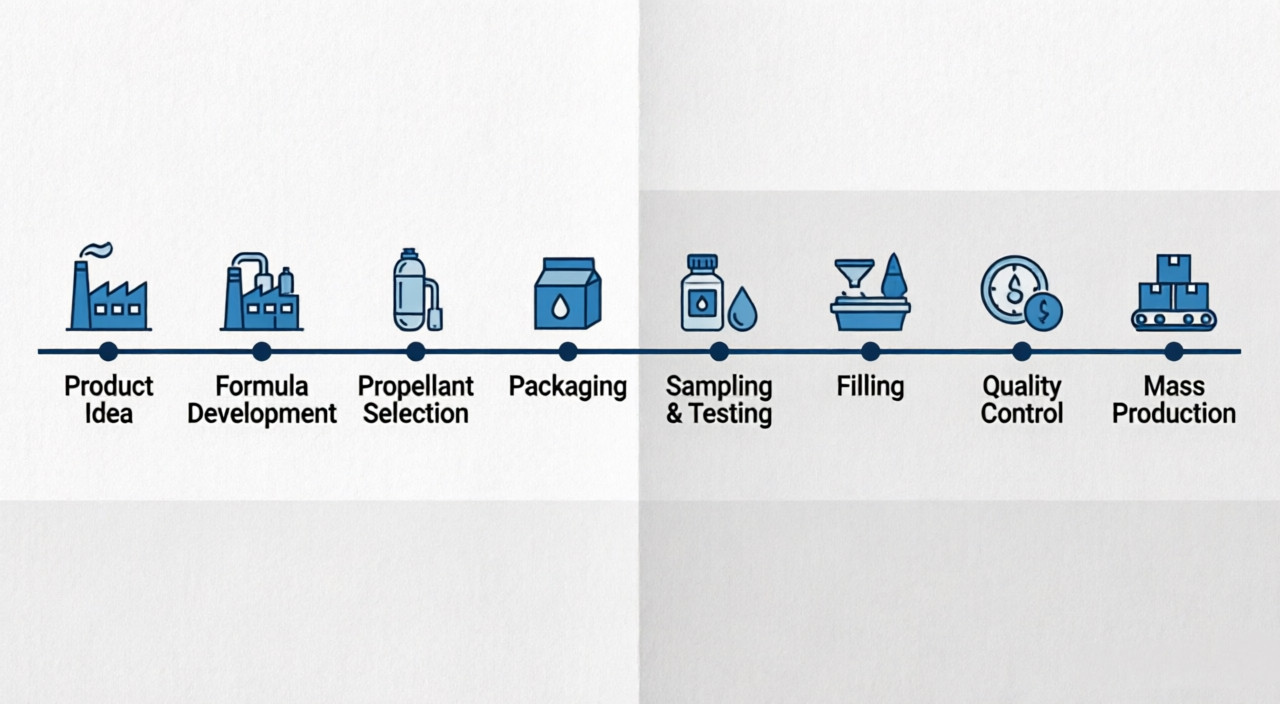
Depending on the project, an aerosol manufacturer may provide formulation development, propellant selection, aerosol filling, packaging customization, quality control, and private‑label production.
This model is widely used for automotive care, industrial maintenance, household chemical, and other aerosol products.
For B2B buyers, understanding the manufacturing process makes it easier to evaluate suppliers and move from a product idea to stable commercial production.
OEM vs. ODM Aerosol Manufacturing
These two manufacturing models have different starting points.
OEM aerosol manufacturing is generally suitable when the buyer already has a formula, product specification, or clear performance requirements. The manufacturer focuses on adapting the product to its production system and completing filling, packaging, and mass production.
ODM aerosol manufacturing provides more development support. A buyer may begin with a product concept, reference sample, target performance, or target market, while the manufacturer assists with formulation, packaging, and production development.
For companies building a new private‑label aerosol range, ODM can reduce the complexity of coordinating multiple suppliers.
How Does Aerosol Contract Manufacturing Work?
A typical project can be divided into several key stages.
1. Product Requirement Analysis
The process starts by defining the product.
Important information includes:
- Product type and application
- Target market
- Required performance
- Packaging size
- Estimated order quantity
- Reference formula or sample
- Private‑label requirements
Therefore, clear requirements help the manufacturer determine the appropriate formulation, packaging system, and production method.
2. Formulation Development
The formulation must match both the intended application and the aerosol dispensing system.
Development may consider cleaning or lubrication performance, drying characteristics, material compatibility, stability, spray behavior, packaging compatibility, and target cost.
However, a formula that performs well as a bulk liquid may behave differently when filled into an aerosol container. For this reason, formulation and packaging should be evaluated together.
3. Propellant Selection
The propellant influences internal pressure, spray characteristics, atomization, and product discharge.
A simplified aerosol propellant types comparison includes:
| Propellant | Key Characteristics | Typical Consideration |
|---|---|---|
| LPG | Strong and consistent spray performance | Flammable |
| DME | Useful solvent characteristics | Formula compatibility required |
| CO₂ | Compressed, non‑flammable propellant | Different pressure behavior |
| Nitrogen | Inert compressed gas | Requires suitable dispensing design |
There is no universal “best” aerosol propellant.
Instead, the correct choice depends on the formula, required spray pattern, packaging system, filling process, intended application, and target market.
4. Packaging and Component Selection
An aerosol package is a complete system consisting of the formula, can, valve, actuator, dip tube, propellant, and cap.
For example, different valves and actuators can produce fine mist, concentrated spray, wide spray, foam, or other dispensing patterns.
Therefore, packaging components should be evaluated together with the formulation rather than selected independently.
5. Sampling and Testing
Before mass production, samples are normally prepared for evaluation.
At this stage, testing may include:
- Spray pattern
- Filling quantity
- Product appearance
- Pressure behavior
- Packaging compatibility
- Application performance
- Product stability
If necessary, the manufacturer can make adjustments before approving the final production specification.
6. Filling and Mass Production
After approval, the project moves into commercial production.
Next, a typical aerosol filling process may include product filling, valve placement, crimping, propellant filling, inspection, actuator assembly, coding, and final packaging.
For growing brands, production flexibility is important.
As a result, the manufacturer should be able to support both customized requirements and larger repeat orders as sales volumes increase.
Why Quality Control and Traceability Matter
Reliable aerosol contract manufacturing requires more than high production speed.
In addition, quality control should cover raw materials, batching, filling, in-process inspection, finished products, and production records.
Meanwhile, digital production management can improve consistency and traceability.
At KingLand, DCS batching is integrated with ERP management to support precise production control and full-chain traceability. In addition, dedicated material handling systems and controlled production procedures help reduce cross-contamination risks.

This is especially important for B2B customers placing repeat orders across multiple products and markets.
What Should You Look for in an Aerosol Manufacturer?
When evaluating an aerosol manufacturing partner, consider more than unit price.
Instead, look at whether the supplier can demonstrate:
- Formulation and R&D capabilities
- Suitable aerosol filling equipment
- Propellant handling capabilities
- Flexible OEM/ODM production
- Quality control procedures
- Batch traceability
- Packaging customization
- Stable production capacity
- Reliable communication and delivery
KingLand operates 6 fully automatic high-speed aerosol production lines, supported by 6 standard lines and more than 10 flexible production lines.
As a result, this production structure can support both high-volume manufacturing and multi-SKU customized projects.
What Information Should You Send for a Quote?
To receive a more accurate quotation, provide your aerosol manufacturer with:
- Product category
- Intended application
- Target market
- Can size
- Estimated order quantity
- Required performance
- Formula or reference sample, if available
- Packaging requirements
- Expected annual volume
However, if you do not yet have a complete formula or product specification, an ODM manufacturer can help develop the project from your initial requirements.
Start Your Aerosol OEM/ODM Project
Successful aerosol products depend on the right combination of formulation, propellant, packaging, filling technology, quality control, and production capacity.
Therefore, working with an experienced aerosol contract manufacturing partner can simplify the process from product concept to commercial production.
KingLand provides OEM and ODM manufacturing support for automotive care, industrial maintenance, household chemical, and selected aerosol product categories.
Planning a new aerosol product?
Send us your product category, target market, packaging size, estimated quantity, and performance requirements to discuss your OEM/ODM project.
Frequently Asked Questions
What is aerosol contract manufacturing?
Aerosol contract manufacturing means outsourcing aerosol product development, filling, packaging, or complete production to a specialized manufacturer.
What is the difference between OEM and ODM aerosol manufacturing?
OEM typically follows specifications provided by the buyer, while ODM involves greater product‑development support from the manufacturer.
How do I choose an aerosol propellant?
Propellant selection depends on the formulation, spray requirements, packaging system, intended application, filling technology, and target market.
Can an aerosol manufacturer develop private‑label products?
Yes. Manufacturers with OEM/ODM capabilities can support private‑label projects, although available formulation, packaging, and customization options vary by factory.