
Introduction
A propellant does more than push a product out of an aerosol can. In fact,it can influence pressure, spray characteristics, discharge behavior, formulation compatibility and the overall design of the aerosol system.
Manufacturers commonly consider four options: LPG, DME, carbon dioxide (CO₂), and nitrogen (N₂).
However, there is no single “best” aerosol propellant. Instead,the correct choice depends on the formula, intended application, container, valve system, required spray performance and applicable market requirements.
Liquefied vs Compressed Gas Propellants
Before comparing individual aerosol propellant types, it helps to understand two basic categories.
Manufacturers classify LPG and DME as liquefied gas propellants. Part of the propellant remains in liquid form inside the container and vaporizes as product is discharged.
CO₂ and nitrogen are compressed gas propellants. The aerosol package stores them under pressure primarily in the headspace.
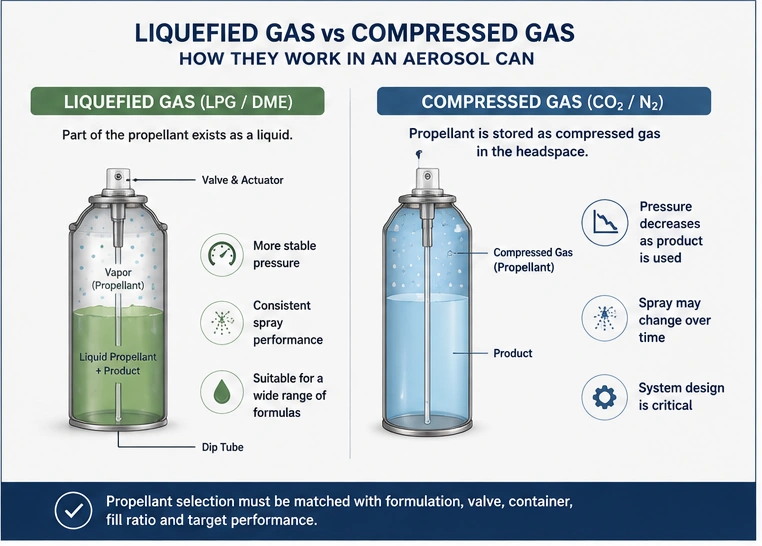
This difference affects pressure behavior and product discharge throughout the life of the aerosol.
1. LPG — Liquefied Petroleum Gas
LPG used in aerosol applications typically consists of hydrocarbon propellants such as propane, butane or related blends.
It is widely used in general aerosol products because liquefied gases can provide effective and relatively consistent product discharge.
Key Characteristics
- Liquefied gas propellant
- Good atomization potential
- Suitable for many aerosol applications
- Pressure can be adjusted through propellant composition
- Flammable
LPG may be found in automotive care, household and industrial aerosol products, depending on the formulation and application.
Because LPG is flammable, product formulation, manufacturing, storage, labeling and transportation requirements must be properly evaluated.
2. DME — Dimethyl Ether
DME is another liquefied aerosol propellant, but its behavior differs from hydrocarbon LPG.
One important characteristic is that DME can interact with formulations differently because it also has solvent-related properties.
Key Characteristics
- Liquefied gas propellant
- Useful solvency characteristics
- Can support effective aerosol dispensing
- Formula compatibility requires careful evaluation
- Flammable
DME can be useful when its properties complement the formulation, but manufacturers should not simply substitute it for LPG without testing.
The propellant and product concentrate need to be evaluated as a complete formulation system.
3. CO₂ — Carbon Dioxide
Carbon dioxide is a compressed gas propellant rather than a conventional liquefied propellant such as LPG.
CO₂ is non-flammable as a propellant, and manufacturers can use it for selected aerosol applications.
Key Characteristics
- Compressed gas
- Non-flammable as a propellant
- Different pressure behavior from liquefied gases
- Usually requires less propellant mass
- Spray performance depends heavily on system design
Unlike liquefied propellants, compressed gases generally experience a greater pressure change as the product is discharged and the available headspace increases.Therefore,
designers need to consider this when designing the valve, actuator, fill ratio and overall aerosol system.
4. Nitrogen — N₂
Nitrogen is another compressed gas option.
It is inert and non-flammable, making it attractive for certain products where these characteristics matter.
Key Characteristics
- Compressed gas
- Inert
- Non-flammable
- Minimal interaction with many formulations
- Requires an appropriately designed dispensing system
Similar to CO₂, pressure behavior changes during product use.
Thus, engineers cannot simply use nitrogen as a direct replacement for LPG or DME. Instead,engineers must design the complete aerosol package around the selected propellant system.
LPG vs DME vs CO₂ vs Nitrogen: Quick Comparison
For a quick overview: a simplified comparison can help B2B buyers understand the basic differences between these four propellant types.
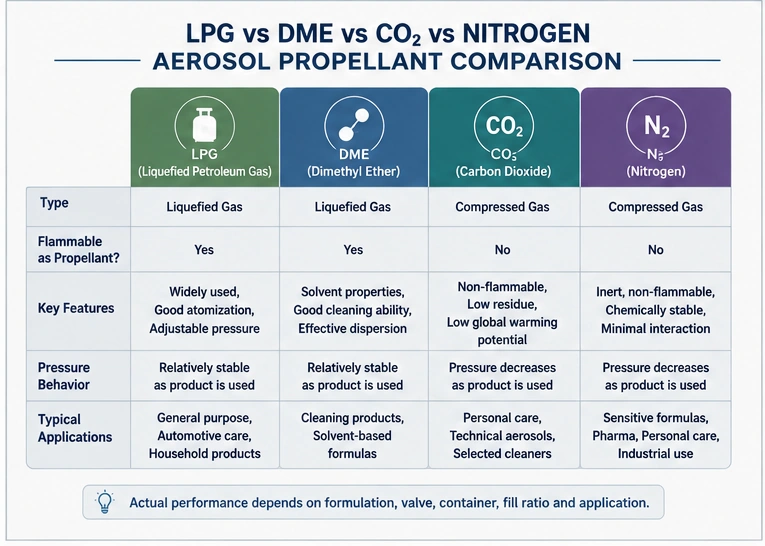
| Propellant | Type | Flammable as Propellant? | Notable Characteristic |
|---|---|---|---|
| LPG | Liquefied gas | Yes | Strong general-purpose dispensing performance |
| DME | Liquefied gas | Yes | Propellant with useful solvent characteristics |
| CO₂ | Compressed gas | No | Non-flammable compressed gas |
| Nitrogen | Compressed gas | No | Inert compressed gas |
Please note that this table provides only a general aerosol propellant types comparison.
Actual performance depends on the formulation, concentration, container, valve, actuator, filling conditions and intended application.
How Does Propellant Type Affect Spray Performance?
So,propellant selection can influence several characteristics of the finished aerosol:
Spray Pattern
Different pressure and valve combinations can produce fine mist, wider spray or more concentrated discharge.
Atomization
The propellant system influences how effectively the product breaks into droplets after leaving the actuator.
Discharge Rate
Formula viscosity, pressure, valve dimensions and propellant type all influence how quickly the product leaves the container.
Pressure Over Product Life
Liquefied and compressed gases behave differently as the aerosol is emptied.
For this reason, changing the propellant may require changes to other parts of the aerosol system.
How Should an Aerosol Propellant Be Selected?
Given these factors,for an OEM or private-label project, propellant selection should begin with the product requirements, not with a preferred gas.
An aerosol manufacturer should evaluate factors such as:
- Product formulation
- Required spray characteristics
- Material compatibility
- Can and valve system
- Target fill volume
- Intended application
- Flammability requirements
- Storage and transportation
- Target-market regulations
For instance, a brake cleaner, lubricant spray, household product and industrial maintenance aerosol may require very different dispensing characteristics.
The same propellant solution should not automatically be applied to every product category.
Can You Change the Propellant Without Changing the Formula?
A common question arises: not necessarily.
Changing from one propellant to another can affect pressure, solubility, spray behavior, discharge rate and compatibility.
Consequently,a change from LPG to DME, or from a liquefied propellant to CO₂ or nitrogen, may therefore require adjustments to the formulation, valve, actuator or filling parameters.
For OEM/ODM development, the formula + propellant + container + valve + actuator should be treated as one complete aerosol system.
Choosing the Right Propellant for Your Aerosol Product
LPG, DME, CO₂ and nitrogen each offer different characteristics.
LPG is a versatile liquefied propellant used across many general aerosol applications.
DME combines liquefied-gas dispensing characteristics with useful solvent properties.
CO₂ provides a non-flammable compressed-gas option for suitable applications.
Nitrogen provides an inert, non-flammable compressed-gas option where the product and dispensing system are designed accordingly.
The final choice should be based on product performance, formulation compatibility, packaging design, safety considerations and market requirements—not on propellant type alone.
For buyers developing a custom aerosol product, propellant selection should therefore be evaluated during formulation and packaging development rather than treated as an isolated purchasing decision.
Developing an Aerosol Product?
KingLand supports OEM and ODM aerosol projects including formulation development, propellant-system evaluation, sampling, filling and private-label production.
If you are developing a new aerosol product, send us your product type, target market, performance requirements, packaging size and reference sample or formula if available to discuss a suitable manufacturing solution.