
Brake Cleaner for Automotive Repair Workshops: Applications and Product Requirements
Brake cleaner is a common maintenance chemical in automotive repair workshops because many brake and metal components can become contaminated with oil, grease, dust, or service residues during repair work.
For workshops, the goal is not simply to use a strong cleaner. A suitable brake cleaner for automotive repair workshops should provide effective cleaning, controlled application, fast evaporation, and appropriate compatibility for the intended task.
Product requirements can therefore vary depending on how and where the cleaner is used.
Where Is Brake Cleaner Used in a Workshop?
Professional workshops may use brake cleaner during maintenance, inspection, or component preparation.
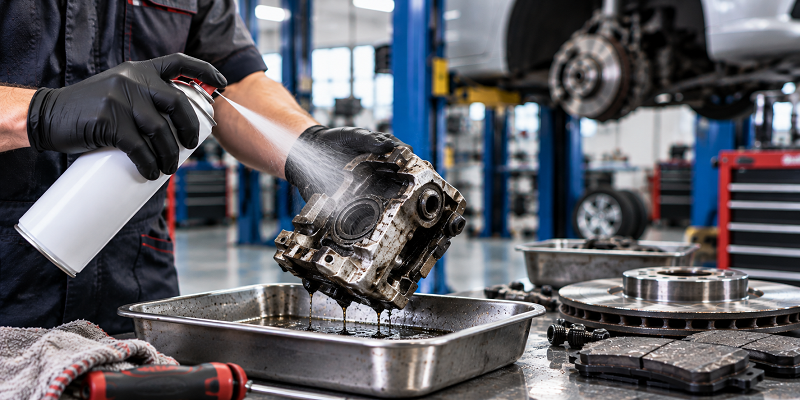
Typical applications include:
- Cleaning removed brake components
- Removing oil or grease from suitable metal parts
- Cleaning tools and selected workshop components
- Preparing suitable metal surfaces before inspection or assembly
- Removing service residues during repair procedures
However, brake cleaner should not be treated as a universal cleaner.
Technicians should always consider the product instructions and material compatibility before applying it to painted surfaces, plastics, rubber, sensors, electrical components, or other sensitive materials.
What Do Workshops Need From a Brake Cleaner?
Different workshops may prioritize different product characteristics, but several requirements are especially important.
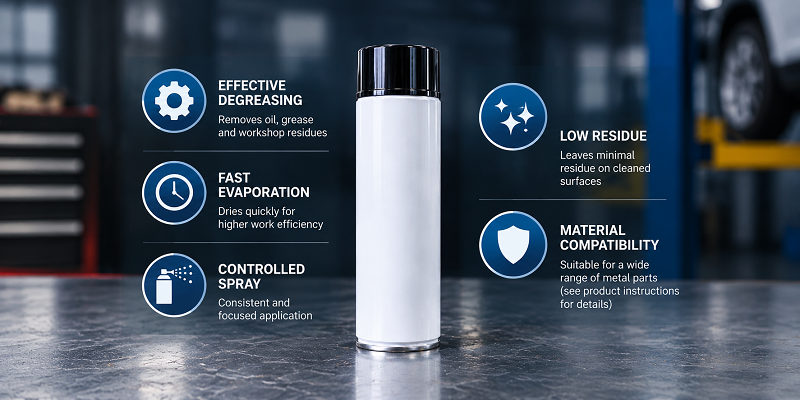
Effective Degreasing
A workshop brake cleaner should remove common oils, grease, and workshop residues efficiently from suitable surfaces.
Strong cleaning performance can help technicians reduce repeated cleaning during maintenance work.
Fast Evaporation
Fast evaporation is often useful because technicians may need to inspect or continue working on a cleaned component shortly after application.
However, evaporation rate should still match the intended application and working conditions.
Controlled Spray Performance
The valve and actuator influence how the cleaner reaches the target area.
A concentrated spray may be useful for targeted cleaning, while other applications may require broader coverage.
Therefore, spray performance should form part of the overall product design rather than being treated as a packaging detail.
Low Residue
For many workshop applications, technicians prefer a cleaner that leaves minimal residue on suitable cleaned surfaces.
This is particularly relevant when surface cleanliness affects the next maintenance step.
Product Compatibility Matters
Cleaning performance alone does not determine whether a brake cleaner is suitable.
The formula must also match the intended materials and application.
For example, some formulations may be more aggressive toward certain plastics, rubber compounds, coatings, or painted surfaces.
For this reason, professional users should follow the manufacturer’s instructions and verify compatibility before use on sensitive materials.
Brake cleaner should also be used in a well-ventilated area and kept away from heat, sparks, and ignition sources according to the product’s safety information.
Packaging Requirements for Workshop Use
Packaging can also affect how practical a brake cleaner is in a repair environment.
Important considerations may include:
- Can size
- Spray rate
- Actuator design
- Valve performance
- Grip and handling
- Product identification
- Carton configuration
A workshop using brake cleaner frequently may value fast and controlled dispensing, while a distributor may also consider shelf presentation, transport efficiency, and carton quantities.
For private-label buyers, these requirements should be discussed early in product development.
What Should Distributors Consider?
A distributor supplying automotive repair workshops should look beyond the product name.
Before selecting or developing a brake cleaner, consider:
- Target workshop application
- Cleaning strength
- Drying behavior
- Material compatibility
- Spray characteristics
- Packaging size
- Local market requirements
- Private-label positioning
These factors help determine whether a product is suitable for professional workshop channels.
They also influence formulation, packaging selection, production setup, and final product positioning.
From Workshop Requirement to Private Label Product
For an OEM or private-label project, the workshop application should guide product development.
A buyer may begin with requirements such as:
Fast cleaning, controlled spray, low residue, and packaging suitable for professional automotive workshops.
The manufacturer can then evaluate the formulation, aerosol system, valve, actuator, packaging, and production requirements together.
This approach helps create a product that matches the intended market rather than simply applying a generic specification.
KingLand supports OEM, ODM, and private-label manufacturing for automotive care and maintenance products.
If you are developing a brake cleaner for professional workshop channels, send us your target market, packaging requirements, reference product or specifications, and estimated quantity to discuss a suitable manufacturing solution.