
Introduction
When developing a private-label aerosol product, one of the first decisions is whether to choose OEM or ODM aerosol manufacturing.
Both models allow brands, distributors, and importers to work with a professional aerosol manufacturer, but the level of product-development support is different.
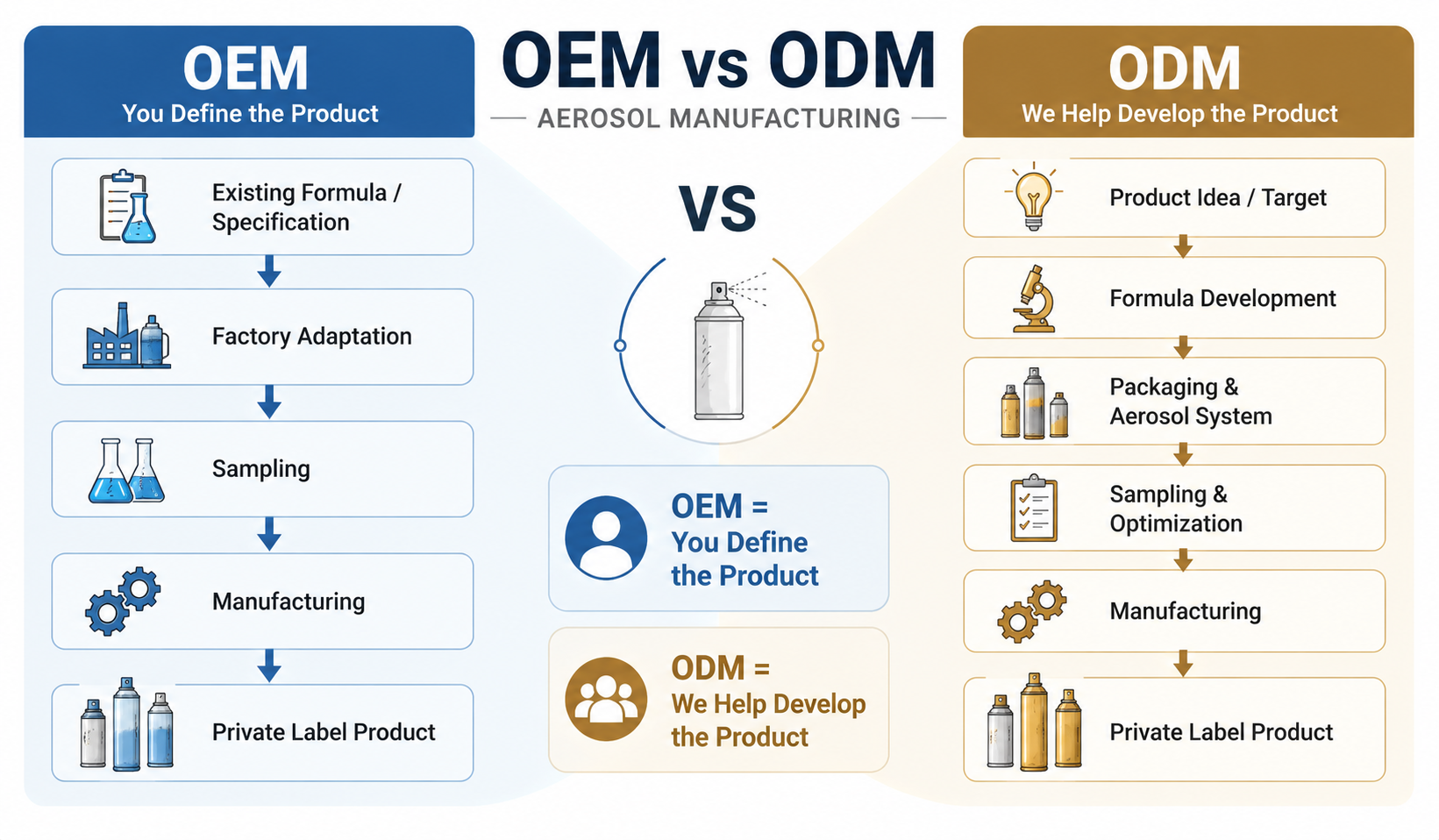
The basic difference is simple:
OEM: You already know what you want the manufacturer to produce.
ODM: You have a product idea or target but need the manufacturer to help develop the final product.
Understanding this difference can help you choose the right approach for your aerosol project.
What Is OEM Aerosol Manufacturing?
OEM stands for Original Equipment Manufacturer.
OEM is generally suitable when the buyer already has a formula, reference sample, technical specification, or clearly defined product requirements.
The aerosol manufacturer may support:
- Formula adaptation
- Aerosol filling
- Propellant and packaging matching
- Sampling
- Quality control
- Private-label packaging
- Mass production
For example, if an automotive care brand already has a proven brake cleaner formula and needs a factory to manufacture it under its own brand, OEM is usually the more appropriate model.
Choose OEM if:
- You already have a mature formula or product.
- You have clear technical specifications.
- You require specific product characteristics.
- You mainly need reliable manufacturing capacity.
- You want greater control over product specifications.
What Is ODM Aerosol Manufacturing?
ODM stands for Original Design Manufacturer.
ODM is more suitable when the buyer has a product concept but does not yet have a complete formula or technical specification.
For example, a distributor may want to launch a private-label automotive lubricant spray but only know the target application, market, packaging size, and expected performance.
An aerosol manufacturer with ODM capabilities can help with:
- Formula development or adjustment
- Raw material selection
- Propellant selection
- Valve and actuator matching
- Sample development
- Packaging recommendations
- Testing and production
ODM can therefore be particularly useful for distributors, new brands, and companies entering a new aerosol product category.
OEM vs ODM Aerosol Manufacturing: Key Differences
| Factor | OEM | ODM |
|---|---|---|
| Starting Point | Existing formula/specification | Product idea/requirements |
| Formula | Usually buyer-defined | Manufacturer can assist |
| Development Support | Lower | Higher |
| Buyer Technical Input | Higher | Lower |
| Customization | High | Depends on project |
| Best For | Mature products | New product development |
Neither model is automatically better.
The right choice depends on how far your product has already been developed.
Should You Choose OEM or ODM?
Ask yourself these four questions.
1. Do you already have a proven formula?
If yes, OEM is usually the natural starting point.
If you only have a product idea or reference sample, ODM may be more suitable.
2. Do you have an internal R&D team?
Companies with their own technical and formulation capabilities may prefer OEM.
Buyers without internal product-development resources can benefit more from ODM support.
3. How much development support do you need?
If you only need filling and manufacturing, consider OEM.
If you need help with formulation, propellant, spray characteristics, or packaging selection, ODM may provide a more efficient route.
4. Are you entering a new product category?
ODM can be useful when expanding into an unfamiliar category because the manufacturer can provide technical and production support during product development.

Is Private Label the Same as ODM?
Not necessarily.
Private label describes the branding arrangement, while OEM and ODM describe how the product is developed and manufactured.
A private-label aerosol can use either model.
With OEM private label, the buyer may provide the formula and specifications while the factory handles production and packaging.
With ODM private label, the manufacturer may help develop the product before producing it under the buyer’s brand.
Therefore, when contacting an aerosol manufacturer, it is useful to explain both your branding requirements and how much product-development support you need.
Choosing an OEM/ODM Aerosol Manufacturer
Whether you choose OEM or ODM, evaluate the manufacturer’s ability to support long-term production.
Important capabilities include:
- R&D and formulation support
- Aerosol filling capabilities
- Quality control
- Flexible production
- Packaging customization
- Batch traceability
- Stable production capacity
KingLand supports OEM and ODM projects for automotive care, industrial maintenance, household chemical, and related aerosol products.
For a broader supplier evaluation, read our Aerosol Manufacturer Selection Guide.

OEM or ODM: A Simple Answer
Choose OEM when you already have a mature formula or detailed specification and mainly need a reliable manufacturing partner.
Choose ODM when you have a product idea, target market, or reference product but need technical support to develop the final aerosol product.
If you are unsure, send the manufacturer your existing product information first. A capable OEM/ODM partner should be able to evaluate the project and recommend an appropriate development route.
Start Your Aerosol OEM/ODM Project
Planning a private-label aerosol product?
Send KingLand your product category, target market, formula or reference sample, packaging requirements, and estimated order quantity.
Our team can evaluate your requirements and discuss whether OEM or ODM is more suitable for your project.
Frequently Asked Questions
What is the main difference between OEM and ODM aerosol manufacturing?
OEM normally starts with a buyer-defined formula or specification, while ODM provides more product-development support from the manufacturer.
Which is better, OEM or ODM?
Neither is universally better. OEM is generally more suitable for mature products, while ODM can be more practical for buyers who need formulation or product-development support.
Can ODM be used for private-label aerosols?
Yes. ODM manufacturers can help develop a product that is then manufactured and packaged under the buyer’s brand.
Do I need my own formula for OEM aerosol manufacturing?
OEM projects generally require clearer product specifications, which may include an existing formula, reference product, or detailed performance requirements.